Thursday, February 25, 2010

The End of the World - Part 2

For those who missed the last post here's the parable of the Ten Virgins retold. It's got a lot to do with the end of the world so you may wanna read it closely.

Ten women go with lamps to await the arrival of the bridegroom. Five of them are prepared with extra oil. Five of them however make no extra preparation. It is what makes them "foolish" for reasons we will soon discover. The bridegroom is delayed in his coming and, tiring of waiting for him, the women fall off to sleep. Suddenly at midnight the bridegroom’s arrival is announced. The women wake up and check their lamps, the ones without surplus oil realizing that their lamps are running dry. They plead with the other women to share their oil, but the women refuse, saying there is not enough to go around. As the women without oil go out to try to find some, the bridegroom comes and takes those who are prepared with him to the wedding banquet. When the foolish women arrive much later, they are not allowed in. "I do not know you," the bridegroom says.

We're the women in the story - Christians carrying the lamps of salvation. The oil is, of course, generally considered a symbol of the Holy Spirit (cf. Exodus 29.7, 27:20, Psalm 133:2, Mark 6:13, James 5:14, Leviticus 8), and some of us are filled with him! As a result, love overflows from our hearts. And joy. And peace. And patience, kindness, goodness, gentleness, faithfulness, and self-control (cf Galatians 5:22-23). That's what happens when your lamp is full. Others among us have just about enough to get us by.

Jesus is the bridegroom and he is a little late in coming (folks have been expecting him for nearly 2000 years!), and we get complacent. Then suddenly - you gotta picture this - you hear the rumble of excited noise and, then, a moment later somebody yells out that Jesus is around the corner and he is headed your way. You do a lamp check and discover that you're short of oil. Very little love. Hardly any peace. You're low on everything. Worse, you got unconfessed sin your life. You have unforgiveness in your heart. There are areas in your life that are unsurrendered. You go out looking to right whatever's wrong and while you are gone, Jesus comes in and takes whoever is ready.

Finally, you get everything sorted and you make your way to the wedding banquet, which is heaven in case you haven't figured it out already. The gates are closed and as you approach it you see a man knocking on it. Jesus comes out and the man says to him, "Jesus, let me in. I'm a believer. I went for mass every Sunday and went for prayer meetings every Friday." But Jesus says to him, "Sorry, buddy, but that won't do. Not everyone who says to me 'Lord, Lord,' will enter the kingdom of heaven, but only he who does the will of my Father who is in heaven" (cf. Matthew 7:21).

As you watch, open mouthed, another man knocks on the gates and says to Jesus. "Lord, let me in. I drove out demons and healed the sick and did other assorted miracles, all in your name." But Jesus says to him, "But you didn't have any love in your heart. Sorry, but I don't know you. Away from me, you evildoer!' (cf. 1 Corinthians 13:1-3, Matthew 7:22-23).

You stand there frozen as yet another man approaches and asks Jesus to let him in. "I'm sorry, but I can't," Jesus replies. "I was hungry and you gave me nothing to eat, I was thirsty and you gave me nothing to drink, I was a stranger and you did not invite me in, I needed clothes and you did not clothe me, I was sick and in prison and you did not look after me.' And the man answered, "Lord, when did I see you hungry or thirsty or a stranger or needing clothes or sick or in prison, and did not help you?' And Jesus replied, "I tell you the truth, whatever you did not do for one of the least of these, you did not do for me" (see Matthew 25:31-46).

What do you think is going to happen to you? Are you going to be allowed in?

These things that I have spoken about are things that Jesus has said. He may have been speaking to the Jews, but His words are equally relevant to us. He constantly cautions us to be careful about how we lead our lives. Faith in Christ Jesus is the only thing we need to be saved, but once we are saved we can't continue to live like pagans. Paul and the other apostles also warn us repeatedly to be careful about this. See Paul's warning to the Galatians:

"The acts of the sinful nature are obvious: sexual immorality, impurity and debauchery; idolatry and witchcraft; hatred, discord, jealousy, fits of rage, selfish ambition, dissensions, factions and envy; drunkenness, orgies, and the like. I warn you, as I did before, that those who live like this will not inherit the kingdom of God."

Paul was speaking to baptized Christians! As a Christian preacher I am duty bound to warn you too, despite the fact that it is an unpopular (and very scary!) message. A lot of people would have you believe that you have nothing to worry about and lulled into a false sense of complacency, you'd probably find yourself sleeping well at night. I would rather keep you awake a few nights here on earth, than have you spending an eternity of sleepless nights. I want to see you there at the wedding feast.

Which brings me to the important question? When is the feast gonna begin? Or, if you want to ask the question in a different way, when is the world going to end? I don't know. It could be five years from now; it could be fifty; it could be five hundred. But what I do know is that for YOU the world ends the day you die. And that could happen at any moment as the people in Indonesia discovered when the Tsunami came and swept them away. Or, more recently, as the people of Haiti found out when the ground swallowed them up; nearly 300,000 of them died in one single blow.

Are you ready?

Friday, February 12, 2010

The End of the World

In the third week of December 2007, while I was in prayer I had a strong sense of God speaking to me, telling me that I needed to speed up on things a little because time was running out on humankind. "I'm going to pour out my grace in great abundance for the next five years," he said. "So make the most of it."

"And after that, what, Lord?" I asked. "You're gonna pull the plug?"

There was no reply, except for a repetition of the same message again, that for the next five years he was going to pour his grace out like never before, but about what was going to happen after that nary a word. God can be pretty annoying with the way he communicates sometimes.

I shared this with a few people who were close to me, and after a lot of subsequent thought and prayer came to the conclusion that — assuming the message was legitimate — God was going to do his best to draw as many people as he could for the next five years after which he would, quite possibly, take a step back and let the pieces just fall where they would.

Fast forward to January last year. I got into a conversation with a neighbor who asked me if I had heard anything about the world coming to an end in December 2012. My first thought was that somebody had told him of the "message" I had received and was getting set to rag me about it, but then decided that he couldn't possibly have heard about it. None of my confidants had big mouths. I asked him what made him think the world was coming to an end. He grinned cryptically and asked me to Google it.

I went home and did as he suggested, my mouth dropping open at the number of links about December 2012 that popped up. It seemed that everybody from the Mayans and the Chinese to the New Agers and certain astronomers believed the world was going to end in that month! A few months later Roland Emmerich got into the act, releasing his extremely popular disaster film 2012 based on these beliefs, leading a lot of people who had seen the movie, especially youngsters, to ask me if the world was ending in two years. For some reason people think preachers have the answers to all questions. Some folks asked Jesus the same question too, but, unlike me, he does have the answers to all questions, so it's best we see what he says.

Jesus had been sitting on the Mount of Olives when his disciples approached him. "“Tell us,” they said, “what will be the sign of your coming and of the end of the age?” (Matthew 24:3).

After a long sermon on the signs they could expect to see, Jesus said he couldn't tell them when he would return. "No one knows about that day or hour," he said, cautioning them to be alert, therefore, because when the day did come, he would come like a thief in the night (cf. Matthew 24:36, 42-44). He then went on to tell them three stories: one about a bunch of women who were invited to a wedding; another about a man who went on a journey leaving varying amounts of money with his servants; and the third about the sorting out of the righteous from the unrighteous after the return of a king. We'll look at all the stories, the first in some detail.

The Ten Virgins (Matthew 25:1-13)
“At that time the kingdom of heaven will be like ten virgins who took their lamps and went out to meet the bridegroom. Five of them were foolish and five were wise. The foolish ones took their lamps but did not take any oil with them. The wise, however, took oil in jars along with their lamps. The bridegroom was a long time in coming, and they all became drowsy and fell asleep. “At midnight the cry rang out: ‘Here’s the bridegroom! Come out to meet him!’ “Then all the virgins woke up and trimmed their lamps. The foolish ones said to the wise, ‘Give us some of your oil; our lamps are going out.’ “ ‘No,’ they replied, ‘there may not be enough for both us and you. Instead, go to those who sell oil and buy some for yourselves.’ “But while they were on their way to buy the oil, the bridegroom arrived. The virgins who were ready went in with him to the wedding banquet. And the door was shut. “Later the others also came. ‘Sir! Sir!’ they said. ‘Open the door for us!’ “But he replied, ‘I tell you the truth, I don’t know you.’ “Therefore keep watch, because you do not know the day or the hour.

As with all the parables that Jesus told, this image is borrowed from the practices and customs of Jesus's times. Let's take a brief look at an Israelite wedding. In an Israelite wedding, the focus was not on the bride, as it is in our weddings. The focus was on the bridegroom.

When the time came for him to be married, he would leave his house, or his parents house, and make his way across town to the house in which all prospective brides waited. He would pick them all up and then make his way back to his house where the wedding celebrations would be held.

It could be pretty late when this happened, and night time in a first century Israelite village could get very dark. If you wanted to negotiate the darkness you needed a lamp, and you had to make sure that it stayed lit.

This is the setup for the story. And this is the story retold:
 
Ten women go with lamps to await the arrival of the bridegroom. Five of them are prepared with extra oil. Five of them however make no extra preparation. It is what makes them "foolish" for reasons we will soon discover. The bridegroom is delayed in his coming and, tiring of waiting for him, the women fall off to sleep. Suddenly at midnight the bridegroom’s arrival is announced. The women wake up and hastily trim their lamps. The ones without surplus oil realize that their lamps are running dry. They plead with the other women to share their oil, but the women refuse, saying there is not enough to go around. As the women without oil go out to try to find some, the bridegroom comes and takes those who are prepared with him to the wedding banquet. When the foolish women arrive much later, they are not allowed in. "I do not know you," the bridegroom says.
 
Next: So what does it all mean?

Wednesday, February 10, 2010

The Frogs

I'm sorry I haven't posted anything lately, but I've been busy talking to catechists, confirmation kids and assorted others over the past few days, I didn't have any time to write anything. But here is something I felt you may enjoy. It was sent to me by a friend this morning (thanks Julie!) and I found it charming.

A farmer came into town and asked the owner of a restaurant if he could use a million frog legs. The restaurant owner asked the man where he could possibly get so many legs.

The farmer replied, 'There is a pond near my house that is full of frogs - millions of them. They croak all night long and drive me crazy!'

So the restaurant owner and the farmer made a deal that the farmer would deliver frogs to the restaurant, five hundred at a time for the next several weeks.

The farmer returned to the restaurant a week later looking rather sheepish. He had with him with two scrawny little frogs. The restaurant owner asked him: 'Well? Where are all the frogs you promised me?'

The farmer replied, 'I was mistaken. There were only these two frogs in the pond. But they sure made a lot of noise!' 

Lesson: Next time you hear someone criticizing or making fun of you, remember, it's probably just a couple of noisy frogs with big mouths.

Also remember that problems always seem bigger in the dark. Have you ever laid in your bed at night worrying about things which seem almost overwhelming ... kinda like a million frogs croaking? Chances are pretty good that when the morning comes and you take a closer look, you'll wonder what all the fuss was about.

Tuesday, January 26, 2010

Methods of Contemplative Prayer

Mother Nadine, founder of Bellwether, more famously known as the Intercessors of the Lamb (http://www.bellwetheromaha.org/), is a friend I made during a visit to Omaha a couple of years ago. She is a contemplative whose writings on the subject you may want to read. One of the methods she suggests is taking "an elevator ride from the mind down to the heart". I found this a useful technique that I adapted to suit my own needs, and I share it with you here.

Find a quiet place — a must for any contemplative prayer — and after a time of worship, imagine getting into an elevator that's stopped on the floor of your mind. You press the button to the heart, and very slowly the elevator begins to descend. It gets slower as it goes down, and quieter as well, until it finally stops at the heart. There you open the door and you find Jesus (or the Father/Holy Spirit) waiting for you. He takes your hand as you step out and leads you to a secluded spot where you begin to engage in contemplative dialog with him. Ask him a question. Wait for an answer. That may lead you to another question. Ask. Listen. But let these questions and answers be heart to heart, rather than mind to mind. When you are done, review the conversation in your mind and extract insights or lessons that you have obtained.

Another good method is Ignatian contemplation, which makes use of active imagination within a selected gospel text. It is a method I followed for years before I discovered that St Ignatius had already put his mark on it, though my method was more meditative than contemplative. Difference below.

Read a passage from the Bible and ponder over it for a few seconds, running the entire scene in your mind's eye. Read it once again to take in any details that you may have overlooked. Read it a third time if you feel the need to do so, then close the book—and your eyes—and put yourself in the scene. Identify with a person or situation in the narrative and re-live what the Bible describes happened. It can prove to be a fascinating exercise.

We followed a similar method a few days ago as we meditated on Jesus's agony in the Garden of Gethsemane (see link) but meditation involves more of the mind, whereas contemplation involves more of the heart. Therefore, when contemplating the Agony, there is more passivity when you re-live the scene, with others controlling the events of the scene and you just going along, making no judgements or comparisons, or trying to arrive at intellectual conclusions.

After you are done contemplating, you go through what actually took place during the time you spent in contemplation, writing down what you felt, thought, etc.

It's a lot of fun, really, and if you do try it, let me know how it went for you. God bless.

Monday, January 25, 2010

The Pillars of Contemplation

Jesus prayed a lot. He understood that prayer was not merely about petitioning God for favors, it was also about seeking his will, and Jesus did so before every major undertaking in his life (and presumably every minor undertaking too). Look at this narrative from Luke as an example:

One of those days Jesus went out to a mountainside to pray, and spent the night praying to God. When morning came, he called his disciples to him and chose twelve of them, whom he also designated apostles: Simon (whom he named Peter), his brother Andrew, James, John, Philip, Bartholomew, Matthew, Thomas, James son of Alphaeus, Simon who was called the Zealot, Judas son of James, and Judas Iscariot, who became a traitor. (Luke 6:12-16)

We can learn a lot about contemplation from this little passage.

Pillar 1: Solitude
One, we see he went to a mountainside. He often went to the mountainside to pray. Why? Mountains are places of solitude. When in solitude, we set ourselves apart from all human beings, so that we can spend time exclusively with God. This is what Jesus advises us to do when he says, "When you pray, close the door and pray to your father who is unseen" (Matthew 6:6:). Not only does this build our relationship with God, time thus spent has remarkable purgative benefits, because it is in times like these that we are often, tried, tested and found to be true. Immediately after his baptism in the River Jordan, Jesus was led by the Spirit into the desert to be tempted by the devil. When he came out, it was in power, ready to begin his mission.

Pillar 2: Silence
Mountains are also very quiet places. I am sitting in my study as I write this. It is a relatively quiet place, with just the occasional aircraft flying overhead and the main door opening and closing to disturb the peace. Yet, I am aware that there is a lot of noise that I cannot really hear because I have become so accustomed to it. I discovered this a month ago when we suddenly had a power cut and all the appliances in the house shut down. Only then did I realize how much noise these devices made. But that is not the only noise there is. There is a perpetual noise in our heads too, with thoughts chasing each other like a million bees. It is so hard to think, much less listen, with all this noise going on, and if we really want to hear the voice of God, we need to have silence all around us.

Pillar 3: Prayer
What was Jesus doing on the mountain? He was praying. Read that as communicating. He was talking to the Father, telling him about the disciples who were following him, and asking which of them he needed to select as his apostles. I imagine Jesus speaking first, telling the Father about each man in turn, and then keeping quiet and listening as the Father started speaking, showing him the men he was to choose, and telling him why he needed to choose them. I imagine the anguish Jesus felt as Judas was named as one of the twelve, knowing the nature of the man and what he was going to do. But, still in prayer, he is comforted and strengthened as his Father explains. This is the real fruit of contemplation: obtaining understanding along with comfort and strength.

Pillar 4: Penance
It was morning before Jesus left the mountain side, having spent the whole night there. I don't think he took a tent and sleeping bag with him, which meant he was probably awake the whole time. Choosing God and his will over everything else will always cause discomfort—and even pain—but with it comes immense blessings as we cooperate with God in fulfilling his plans for us in our lives. Jesus didn't begin carrying his cross the day he walked toward Calvary; it began the moment he began his mission, and it is the same for us. Jesus said, "Anyone who does not carry his cross and follow me cannot be my disciple" (Luke 14:27). We often believe that carrying a cross means carrying the burdens of life, but in Jesus's time carrying a cross meant only one thing: it meant death. We need to die, too, not so much to our body as to ourselves, and contemplative penance is a way of preparing ourselves.

Next: Pathways to Contemplation

Sunday, January 24, 2010

Christian Unity: Do We Really Want It?

The Week of Prayer for Christian Unity began in 1908 as the Octave of Christian Unity, and focused on prayer for church unity. The dates of the week were proposed by Father Paul Wattson, cofounder of the Graymoor Franciscan Friars. He conceived of the week beginning on the Feast of the Confession of Peter, the Protestant variant of the ancient Feast of the Chair of Saint Peter, on 18 January, and concluding with the Feast of the Conversion of Saint Paul on 25 January. That's tomorrow.

Our parish has been making a prayer for Christian unity in all its masses and the entire congregation drops to its knees as one. Yet, as we pray, I can't help wondering if we really want it in our hearts, given the prejudices we harbor against our Christian brethren. I reproduce an article that I wrote a few years ago here and invite your comments.

Ending the Catholic Protestant Divide

King Solomon was the third King of Israel. He was famed for his wisdom, and many people came to him for justice from far and wide.

One day, two prostitutes came before King Solomon, each claiming that the child they brought before him was hers. They had both recently given birth to a child but during the night one of the prostitutes rolled over her child and killed it. She exchanged her dead baby with the live baby of the other prostitute while she slept. When the other prostitute awoke, she found her baby dead but realized, upon close examination, that the dead baby was not hers.

So who did the baby belong to?

King Solomon ordered that a sword be brought and the baby be sliced in two, with each woman given one half. One of the prostitutes nodded her assent, saying she believed that justice was being done. The second woman, however, screamed a protest saying that the other woman could have the baby, but not to kill it. Solomon promptly had the baby given to her.

I heard this story as a child and I don't remember being particularly impressed by it. What person, no matter how miserable he or she was, would have it in their heart to have a little baby cut into half, I wondered. But after I returned to the faith, I realized that not only did a lot of people have it in their heart to do so, they went about it with great enthusiasm. I refer, of course, to us Christians from all sides of the divide who use the sword, which is the Word of God, to cut the baby, which is the body of Christ, into little, little pieces!

It is not hard to see why. There is tremendous pleasure — and power — you get from wielding this particular sword, and the temptation to do so is often overpowering, even when you don't quite know how to use it. Or, perhaps, especially when you don't know how to use it. I must confess to being tempted to do so myself on several occasions. When I first started reading the Bible, for instance, I remember coming across several references to Jesus's brothers, which disturbed me greatly, because I knew that Catholic dogma stated that Jesus had none and here it seemed "obvious" that he did. I promptly went to Jesus and asked him outright, "Jesus, did you have brothers?"

"How does it matter?" he asked quietly. "Would you love me less if I did?"

The questions threw me entirely off balance. "No, I wouldn't," I answered finally. "I just wanted to know the truth."

Jesus merely smiled.

That smile shamed me. He knew it wasn't the truth I wanted. What I was really looking for was a sharpened blade to cut down my opponents. Which is what a lot of us Christians use the Word of God for. We ignore the prime commandments to love God and love our fellowmen and focus on things that will lead us to widen the rift between us and hate each other more. And we do it in the name of truth!

This isn't to say that truth is not important. It is. There are truths that I hold dear to me. And I will die for some of them because I believe that there are truths worth dying for. But I do not believe that there is any truth worth killing for. God's Word does not tell me otherwise. There is nothing in the Bible that says I should take you out into a dark alley and pound the truth — or what I believe the truth to be — into you so that you may be saved. Or that I should savage you in an argument, leaving you wondering if salvation requires erudition or faith in Jesus.

I rarely get argumentative on issues of theology; it tends to be unproductive. If asked what I believe to be true, I state my beliefs. If asked why I believe what I believe to be true, I explain the reasons for my beliefs. But only if the questions are asked with a desire for understanding, not confrontation. If the latter, I simply mumble something about how Matthew 7:6 makes for a good answer and walk away. I have enough forums to state my views if I am inclined to do so and it is then entirely up to the people who choose to read what I write, or listen to what I say, to accept what I say or reject it. I am happy if they do the former, and though I might be a trifle disappointed if they do the latter, I don't let myself get unduly upset; I see no reason why I don't have to get along with somebody because he happens to disagree with me.

Holy Spirit Interactive is one of the forums that I use to state my views and thus far has been a superb forum. It is Catholic and unashamedly so. So am I and so are most of the writers who write for it. We all write about issues related to our faith. But the reason we write is not to cut down our Protestant brothers (for whom we have the deepest affection), but merely to teach Catholics about their faith. Blind faith is not something God asks us to have and it is important to know why we do what we do and why we believe what we believe. This often has to be taught. If there is something that others can learn about our faith, they are welcome to find out about it here. It might give them more understanding of the immense body of knowledge and wisdom the Church has gathered over 2000 years, and also let them know that much of the prejudice that they have inherited is unwarranted and needless.

There is no shame in learning from us, just as there is no shame in us learning from them. I have learned a lot from my Protestant friends over the past several months and so, I am sure, has the Catholic Church over the years. We can learn a lot from one another if we can only stop the ungodly hatred that flows through our hearts and come together in love. We do not have to resolve all our differences to do this; we share enough in common for the differences not to matter. All we need to remember is that we are all one family, parts of this huge wonderful body of Christ, and there will be so much of healing that we can bring to the world if we can come together in love. It is simply doing what Jesus asked us to do, after all. Love one another, he said. And if we do, then the song we sing about them knowing we are Christians by our love will be more than a series of words strung together by a pretty tune. It will become a truth. A truth worth dying for.

Saturday, January 23, 2010

Contemplation: Heart to Heart Communication

Jesus said: "When you pray, go into your room, close the door and pray to your Father, who is unseen. Then your Father, who sees what is done in secret, will reward you" (Matthew 6:6).

If we need to develop intimacy with somebody, anybody, we need to spend time alone with them. We might meet someone we like at a party, but there is only so much we will get to know about that person in the midst of so many others. To further the relationship, a certain degree of privacy is required. It is the same with God. If we want to get to know him better, we need to get to some place quiet. Some place where we will be alone with him. Some place where nobody can see us or bother us.

And once there, what? Jesus has the answer to that too. "And when you pray, do not keep on babbling like pagans, for they think they will be heard because of their many words. Do not be like them, for your Father knows what you need before you ask him" (Matthew 6:7,8). Simply put, once there, shut up and listen.

Many of us are used to communication that involves using a lot of words, usually ours, and that is carried foward to our communication with God as well. There are times when it is okay, even necessary, to say things to God; but, if we are to develop a deeper relationship with God, we need to let him do the talking with us doing the listening. And it's best when this listening is done from the heart. That is contemplation.

Through it, we get to know the heart of the Father, Jesus and the Holy Spirit. The more we get to know them, the more we begin to love them, and the more we love them, the more we are prepared to do for them, which helps us immensely on our journey up the mountain. Contemplation also helps us to yield to the Spirit (see Surrender Your Life to God), achieving the purification that we all (hopefully) seek. And, thirdly, contemplation helps us discern his will and his plans for us. We often blunder through life without the faintest clue of what God wants us to do, and this applies even to "spiritual" people. Listening to God's voice in contemplative prayer helps to bring meaning and focus to our lives.

Next: The Pillars of Contemplative Prayer

Friday, January 22, 2010

In the Garden of Gethsemane: Discovering Meditation

The very first psalm in the Book of Psalms begins with these lovely words of encouragement:

Blessed is the man
who does not walk in the counsel of the wicked
or stand in the way of sinners
or sit in the seat of mockers.
But his delight is in the law of the LORD,
and on his law he meditates day and night.
He is like a tree planted by streams of water,
which yields its fruit in season
and whose leaf does not wither.


Christian meditation is often associated with prayer or scripture study, and comprises largely of continual, focussed thought on God and his word. It is not as difficult to meditate as people imagine. In fact, most of us are experts in meditation. Do you worry about anything? That's meditation! Continued, intent, focussed thought on something. (Do you have a credit card? That's cause enough for a little meditation. Do you have two? Double cause. Six or seven cards? I can practically guarantee that you are a serious meditator.) Such meditation does nothing for us besides giving us ulcers and shooting up our blood pressure. Meditating on God's word, however, has some benefits. "Do not let this Book of the Law depart from your mouth; meditate on it day and night, so that you may be careful to do everything written in it. Then you will be prosperous and successful" (Joshua 1:8).
 
Paul, advises us to think about "whatever is true, whatever is noble, whatever is right, whatever is pure, whatever is lovely, whatever is admirable—if anything is excellent or praiseworthy—think about such things" (Philippians 4:8). These things that we need to ponder about are all found in God's word, and meditating upon them will help us to follow another sage bit of advice from the apostle: "Do not conform any longer to the pattern of this world, but be transformed by the renewing of your mind. Then you will be able to test and approve what God’s will is—his good, pleasing and perfect will" (Romans 12:2).
 
Many Catholics are fond of saying the Rosary. The Rosary is a meditative prayer, where we focus on the life of Jesus. Most people just rattle it as though the mere saying of them will grant all our petitions like some magic mantra, but if we pray it as we should, it can bring about a lot of insight and understanding. Let us look at one of the sorrowful mysteries, the Agony of the Lord in the Garden of Gethsemane.
 
Jesus went out as usual to the Mount of Olives, and his disciples followed him. On reaching the place, he said to them, “Pray that you will not fall into temptation.” He withdrew about a stone’s throw beyond them, knelt down and prayed, “Father, if you are willing, take this cup from me; yet not my will, but yours be done.” An angel from heaven appeared to him and strengthened him. And being in anguish, he prayed more earnestly, and his sweat was like drops of blood falling to the ground. (Luke 22:39-44)
 
Let us get into the garden with Jesus and do some meditating there. Jesus is in agony. Why is he in agony? Because he has an idea of what is going to follow—the pain and the tortuous death. Cause enough for mental anguish, but is that it? Surely he knew that is what he came for. Could it be something else? Perhaps. Why does he have to go through the pain? Why does he have to die? Because a sacrifice was needed, one that was permanent; one that would reconcile us to God for all time. How was he going to be that sacrifice? By taking on our sins upon himself. What would that have made Jesus in the eyes of his father? The most loathesome creature on this earth. Jesus had never been separated from the Father for all eternity; to be separated from him now and that too in a manner like this; how would that make Jesus feel? And then comes the insight, the understanding, of what caused Jesus's tremendous agony and the realization that the sacrifice that he made was even greater than we had previously ever imagined .....
 
There is a lot that I wish to share in this series, but as I will be putting my thoughts down in no particular order this series may appear a little disconnected. I will rectify this at a later date when I have some more time on my hands. In the meantime, I hope that you will find something useful in these little notes.

Wednesday, January 20, 2010

Still Standing in California

After posting my picture of the cross standing in Haiti, another friend, this time Shellan from Sri Lanka, sent me this set of pictures. Once again, I don't know who took them.


Look at the lower right


The Day After

Step 4: Be Filled with the Holy Spirit

One of the most sensational narratives in the Bible can be found in Acts 2. Peter preaches his first sermon and by the time he is done talking, 3,000 people had accepted Christ as their savior. Just a few minutes earlier Peter had been cowering along with the other apostles in his house, afraid for his life. We had seen, earlier (see Step One), how he had betrayed Jesus despite his best intentions to stay by Christ's side. What happened to this man, never known for his great courage? What made him go out among the people, some of them responsible for the death of Jesus, and proclaim the good news to them without fear?

The power of the Holy Spirit.


When the day of Pentecost came, they were all together in one place. Suddenly a sound like the blowing of a violent wind came from heaven and filled the whole house where they were sitting. They saw what seemed to be tongues of fire that separated and came to rest on each of them. All of them were filled with the Holy Spirit and began to speak in other tongues as the Spirit enabled them. (Acts 2:1-4)

We see this power manifest time and time again. In Acts 4, Peter, filled with the Holy Spirit, defends himself before the Sanhedrin, uttering words of immense wisdom. Jesus had promised this. But when they arrest you, do not worry about what to say or how to say it. At that time you will be given what to say, for it will not be you speaking, but the Spirit of your Father speaking through you. (Matthew 10:19-20)

In Acts 4:31, we find the apostles, filled with the Holy Spirit speaking the word of God boldly. In Acts 6, we find Stephen, full of God's grace and power, doing great wonders and miraculous signs. In Acts 13 we find Saul, filled with the Holy Spirit, exposing the evil in people around him. Every single miracle in the New Testament performed by the apostles was through the power of the Holy Spirit.

Even the Old Testament recounts what happens when people are filled with the Spirit of God. In Judges 6:34, Scripture says the Spirit of the LORD came upon Gideon and we see him and his small army of 300 men securing a magnificent victory over a huge force gathered against him. In Judges 14:6, we find a similar account of Samson: The Spirit of the LORD came upon him in power so that he tore the lion apart with his bare hands as he might have torn a young goat. Scripture speaks about how the Holy Spirit moved in the lives of Moses, Joseph, David, Saul and several others in the Old Testament.

There is one notable difference, however, in how people received the Spirit in the Old Testament from how they did in the New. In the Old Testament, the Spirit was given to a few select people for a specific purpose, given by God solely according to his discretion. In the New Testament it is given to every single person who accepts Jesus as his savior. Which means that if you are a Christian who is reading this, you have the Holy Spirit within you. But if you aren't feeling his power manifest in your life, as in the lives of those we have briefly looked at, it is not because he is weak within you, but because you are not yielded to him. If you want to experience his power, simply turn yourself and all you have to Jesus. This is why the third step (see Step 3) is so important. We need to surrender everything we have into his hands. We need to surrender ourselves.

May the Spirit be with you.

Tuesday, January 19, 2010

Step 3: Surrender Your Life To God

The third step to moving from a life that is with Christ to a life that is in Christ is to surrender it into his hands. It is not something that many of us find easy to do given the connotations of the word (to yield, give up, submit, abandon, relinquish, cede, waive), or the negative associations it brings to mind (defeat, arrest, capitulation). With Christ, however, it doesn't bring about a loss of freedom (or a loss of face), but strangely enough, an increase of it.

Consider a problem that you currently face—and don't tell me you don't have any problems because I won't believe you! It could be a relationship that isn't working satisfactorily, a financial difficulty, an addiction that you are struggling with, a health issue pertaining to you or somebody in your family, a persistant sin, a slandered reputation, or one of a million other possible things. You worry about it/them constantly, getting more and more frustrated at your inability to resolve the problem. You are burdened with it. You are chained to it. You are a prisoner to it. Where is the freedom?

Now, when we surrender everything into God's hands we relinquish all that we are holding on to, including our problems, and when he takes them over, we are free! (Picture carrying a sack of bricks on your back that you just swing over to Jesus for the right imagery!) We can't surrender, however, without the acknowledgement that God is in control over everything, including the circumstances of our lives. How do we get that understanding? Consider what Jesus once asked a crowd of anxious listeners.

"Who of you by worrying can add a single hour to his life ? Since you cannot do this very little thing, why do you worry about the rest?" (Luke 12:25-26)

Surely we will all acknowledge that none of us can add a single minute to our lives, much less a single hour. We cannot because God is in control of our life. And if God is in control of the most important thing in our lives, which is our life itself, doesn't it stand to reason that he is control over everything about our lives—our families, our health, our finances, everything. Then, why try to believe that we are in control and thus imprison ourselves?

"I tell you, do not worry about your life, what you will eat; or about your body, what you will wear. Life is more than food, and the body more than clothes. Consider the ravens: They do not sow or reap, they have no storeroom or barn; yet God feeds them. And how much more valuable you are than birds! (Luke 12:22-24)

So give it all to him, not just your problems and your troubles, but everything—heart, mind, soul, body—and let him take full control. And just see what happens next.

Monday, January 18, 2010

Still Standing in Haiti


I don't know who took this picture, which was sent to me by a Lebanese friend Joseph Khadige, but it states a truth in a far more effective way than a thousand words. Let us pray that all the surviving in Haiti who lived away from the light turn from their wicked ways and back towards God.

Tuesday, January 12, 2010

Step 2: Give the Truth of Your Heart to God

One Christmas season, Johnny and his sister Sally visited their grandparents on their farm. Discovering a slingshot, Johnny happily tried to shoot down a few mangoes. His aim was terrible, however, and after spending an hour hitting everything on the tree but mangoes, he decided to head back to the house. On the way he spied his grandmother's pet duck and impulsively let loose with the slingshot, believing he would miss it as he had missed everything that morning. To his astonishment, he hit the duck right on its head. To his horror, the duck dropped dead.

When he recovered from his shock, he decided the best thing to do was to cover up the evidence of the crime and pretend nothing had happened. Quickly, he dug a shallow grave and after giving the ill fated duck a hasty burial he returned to the house believing it to be the end of this sad story. If he had read King David's story in 2 Samuel 11-12, he may have learned that cover ups don't end any stories; they just result in horrible repurcussions!

After dinner, Johnny's grandmother turned to his sister and told her to help out with the dishes. But his sister said, ""Grandma, Johnny told me he wanted to help in the kitchen." As the boy opened his mouth to protest, Sally turned to him and said in a savage whisper, "I know about the duck!" She didn't have to say more. Johnny did the dishes.

That began the most horrible time Johnny had in his entire life. He ended up milking the cows, taking out the trash, sweeping the cobwebs out of the attic, washing the windows and doing other assorted chores, while his sister frolicked her way through the holidays. Finally Johnny could stand it no longer, and he decided to end his agony by confessing his deed to his grandmother.

He was in for another shock. When he went to apologize to his grandmother, she told him that she knew what had happened. "I was standing at the window and I saw the whole thing. But because I love you, I forgave you. I was just wondering how long you would let Sally make a slave of you."

I don't know who the author of this story is, but he has been brilliant in illustrating an important scriptural truth—although it is probable this may not have been his intention. The truth is this: God knows everything we do, and when we lie to him about the sinful things we do, we only end up letting Satan manipulate us and make slaves of us.

Many of us get trapped like this. We begin by lying to others, trying to conceal our weaknesses and failings from them so that they will not think less of us. We then become so adept at lying to others, we begin to fool ourselves in thinking all is right when it isn't. We eventually end up lying to God, justifying our sinful thoughts and actions. The devil has a field day!

When, however, we take the truth about our feelings to God, we take away the power the devil has over us and open ourselves to the grace of God that allows us to overcome our weaknesses and failings. Try it and see if this doesn't work. The next time somebody makes you mad, don't put on your best face and act like nothing has happened. Tell God how miserable you are and see how quickly he makes you feel better. The next time you are attracted to somebody, don't try to pretend you aren't because you are afraid it might hurt God. Confess your feelings to him and notice how his grace sweeps over you blowing the temptation away.

Take the truth of your heart to God. That's step 2 to being in Christ.

Tuesday, January 5, 2010

Step 1: Come As You Are; I Love You

Luke 22:31-62 relates one of the most touching stories about the nature of Jesus that can be found in the entire Bible. Shortly after the last supper that Jesus had with his disciples, where he spoke about his impending death, Jesus says something very strange to Peter.

“Simon, Simon, Satan has asked to sift you as wheat. But I have prayed for you, Simon, that your faith may not fail. And when you have turned back, strengthen your brothers.” (Luke 22:31-32)

Jesus knows that Peter is going to deny him—his comment about Peter turning back suggests that—yet he tells Peter that he is not praying that he stays firm, or remains courageous, but that his faith may not fail. Faith in what? We will discover that before we come to the end of this story.

Peter, never really quick on the uptake, doesn't understand what Jesus is telling him, and doesn't ask him to explain either. He grandly tells Jesus that he is ready to die with him.

“Lord, I am ready to go with you to prison and to death.”

Jesus answered, “I tell you, Peter, before the rooster crows today, you will deny three times that you know me.” (Luke 22:33-34).

As we know, that is exactly what happened. Soon after Jesus was arrested and taken into the house of the high priest, Peter tried to hide himself among the crowd, but he was recognized by a servant girl. “This man was with him.” she said. But he denied it. “Woman, I don’t know him.” A little later someone else saw him and said, “You also are one of them.” “Man, I am not!” Peter replied. About an hour later another asserted, “Certainly this fellow was with him, for he is a Galilean.” And Peter replied, “Man, I don’t know what you’re talking about!” Just as he was speaking, the rooster crowed. (cf. Luke 22:56-60)

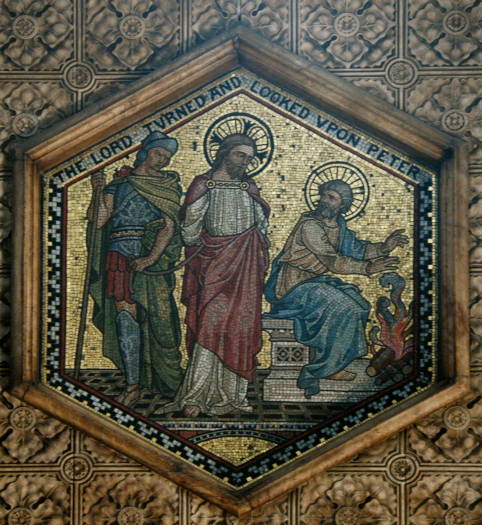
Scripture then says, "The Lord turned and looked straight at Peter" (Luke 22:61)


The Lord Turned and Looked Upon Peter
Photograph by George P Landow courtesy The Victorian Web
I believe that this was a moment of tremendous significance for Peter—and consequently for the Church—because it was in that moment that Peter's life changed completely. He remembered what Jesus had said about his betraying him and stricken with remorse and guilt he went out and wept bitterly. And, although Scripture doesn't say what happened here, I think that the image that kept flashing before Peter's tear filled eyes as he wept—grieving over his betrayal, grieving over his cowardice, grieving over his failure—was the look in Jesus's eyes. It was not one of condemnation, or of anger, or of disappointment. It was simply one of love.

Peter believed in that love and turned back. The prayer that Jesus had made was answered. The faith that Jesus wanted Peter to have was faith in his love, his forgiving love.

In stark contrast to Peter was another apostle, Judas, who also messed up, but he thought his sin was beyond redemption. He didn't believe that God's love was so great, it would forgive him his betrayal and he went and hanged himself.

Many of us, unfortunately, are more like Judas than Peter, believing God to be an angry, vengeful God, quick to punish us for our wrongdoings. We can't be further from the truth. God is our father, who wants nothing more than for us to come back home to him, and when we do, punishment is the last thing on his mind because he is simply too happy to be angry. The Parable of the Prodigal Son illustrates this remarkable truth, and it can be seen exemplified in the life of every single sinner who has returned home to the father, including this author (see Return of the Prodigal).

He also does not ask us to change before we go to Him. Many of us believe we need to be perfect before we approach Him, but as we can never be that, we never end up going to Him at all. But as the Parable of the Prodigal Son also teaches, we need to go Him as we are. The son in this story was starving and filthy, clothed in rags, stinking to high heaven, but his father nonetheless gathered him in his arms and embraced him as he was. We don't need to change first either. We can go to him as we are, and then he will change us with his love.

"Come as you are," the Father says. "I love you." Let us believe that and go just as we are.